
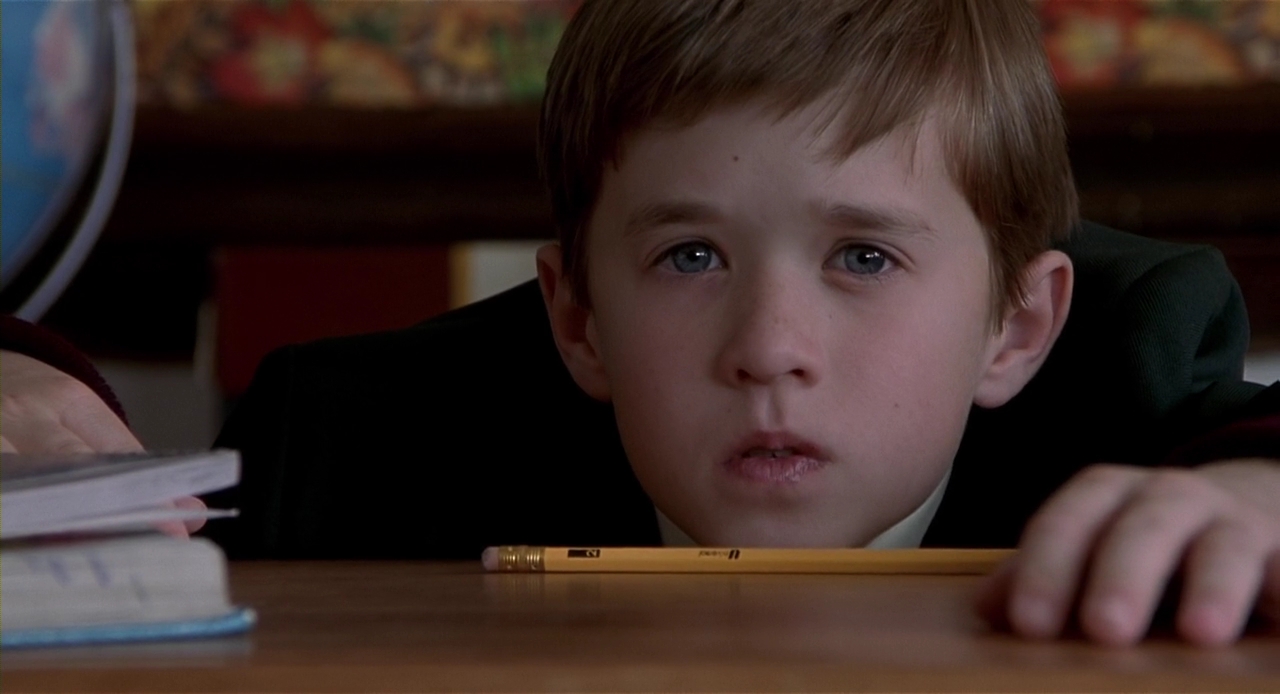
video review : The Sixth Sense

video review : The Sixth Sense

If I saw dead people “everywhere” all the time, I think I’d eventually get used to it, at least to the point where it doesn’t scare me anymore. Not nine-year-old Cole Sear. They still scare him and he’s been seeing them all his life. It’s a secret he keeps to himself, so when he reacts to them, alive people think he’s crazy. I thought he was too until I started to see the ghosts for myself. I wasn’t scared though. I was more dumbfounded than anything else. How, I wondered, are these ghosts wearing clothes?

My snide thoughts were more entertaining than this movie; a slow-paced psychological thriller that doesn’t really thrill until the end. It’s a twist ending if there ever was such a thing; one I was surprised thus impressed by. It almost made me want to watch the movie all over again to see how they pulled it off, but I wouldn’t subject myself to that. It’s too boring for too long. As the kid says to the psychologist while he’s trying to tell him a bedtime story, “You have to add some twists and stuff.”

my rating : 2 of 5

1999

video review : AI [ Artificial Intelligence ]

video review : AI [ Artificial Intelligence ]

Intelligence? Not so much. This movie is stupid most of the time. That starts at the initial premise; the creation of a robot child, a Mecha, designed to “love”. It’s a loaded term that is never clearly defined, but, judging by the behavior of the boy, it apparently has to do with romantic obsession. The fact that it’s his adoptive Mommy he feels that way toward gives the story an incestuous underlining. The ending, in which the two spend the day together and gaze into each other’s eyes to dreamy orchestral music, gets downright pedophilic. I was waiting for them to start fucking.

Still their relationship and the things that happen around it during the first third of the movie is the best part. It leads to a genuinely despondent abandonment scene; one of the few times Steven Spielberg’s heartstringing actually works. From there the tone changes from psychological drama to action adventure; the boy, his toy bear and an expendable Mecha man must find their way to The Blue Fairy before being killed by the evil humans; back to a different kind of psychological drama. It’s that last third, an extended epilogue, that comes across as meandering and pretentious.

If AI is supposed to represent some big important metaphor or make its audience ponder deep philosophical questions, the effort is lost on me. My questions have more to do with the logic of the plot, like how can the boy survive for years under water if he breaks when he tries to eat a few spoonfuls of spinach? Why do the “parents” bother sitting him at the family dinner table with a plate of food if he can’t eat? Why was the child programmed to love only the mother and not the father? They’re petty arguments, but asking them is more engaging than anything this new-age Pinocchio has to offer.

my rating : 2 of 5

2001