
No.
Category: general
going to and from school as a kid
I always got rides to and from elementary school, which would’ve been too far to walk even if I’d been old enough to do it on my own. My mother might’ve drove me there most mornings; I remember her being there the time I was too shy to come to the door when the girl I had a crush on held it open for me in kindergarten or first grade; but I think it was my grandmother who usually drove me home. She’d pick me up in her old gray car with the brown vinyl seats. I still remember the way it smelled. The only time I remember my mother picking me up was after my senior trip to Boblo.
Middle school was close enough for me to walk as I did in the morning and back home most days. I was nervous about it at the beginning, especially after seeing Morrell getting beat up by a group of boys, but I quickly got used to it. In fact, while I wouldn’t go as far as to say it’s something I enjoyed, I didn’t mind it. It was more of a leisure than a burden except for the day I got sucker-punched. The kid walking ahead of me took-off running when he saw the gang, but I was too clueless to follow. Then there was the time Chantelle; another girl I had a crush on; tried to bully me with her friends.
In the seventh or eighth grade, I started walking home with my best friend Derrell. We’d walk up Conant until we got to Six Mile, literally halfway from my house, then part ways. I remember the day we stopped to have a wrestling match for the faux federation we ran at the school, much to the entertainment of the two boys who stopped to watch. One of them said, with a laugh and a smile, that he could tell I was The Undertaker by the way I lifted the lid to the garbage can as if it were a casket. I think I beat Derrell that day, by his own decision, since we never really wrestled to pinfall.
My brother Tobe picked me up the day either Henry or Eugene hit me in the eye, just millimeters from the pupil, with a flying paper clip or something similar. I remember being in the office when the secretary started laughing at the fact that my brother arrived to pick me up on a bicycle. He drove Derrell home one day too; in his car or jeep; the day he (Derrell) slipped and almost fell getting out. That was hilarious. My mother picked me up on some days in her minivan. I remember James seeing her and making comments that suggested he was sexually attracted to her. Dry heave.
Other middle school memories include kids lying in the street then jumping up to startle on-coming traffic, the aftermath of a lump-headed boy who just got hit by a car, a trench-coated smoker named Frank who used to walk with me sometimes, walking to school with a boy who said he had a gun in his pants and being held at gunpoint by cops who claimed I fit the description of their suspect. Eyewitness Eugene asked me about that particular incident later that day. I also remember Tobe, more than once, driving me and Johnny to school to Spice 1’s Fuckin Murderer song.
I attended four different high schools. Walking to and from, or at least from, the primary one was something I generally enjoyed. Though the trip was a little further than middle school; about a mile and a half; it was a better experience. That’s mostly because it was a lot less dangerous, or at least it seemed to be, as bullies and such had more-or-less become a thing of the past. One thing I often did to pass the time was rap (freestyle) to myself, in my mind, to imaginary beats, which I actually started doing in middle school. It just became more of a tradition in high school.
I can remember getting rides to and from that particular high school only a few times. My uncle Gabe took me the time I needed a parent or guardian to get me back in after I got suspended. My Big Brothers mentor Richard picked me up in his gold Lexus on at least one occasion. It was probably the day he stopped by to get some books from mister Kidney. My art teacher took me home one day. I’d walk most days though and usually alone. I started walking home with friends like Michael, Derek, Sabrina and Joi toward the end, at least as far as we could before parting ways.
My other high schools, which I attended for shorter periods of time, gave me a break from all that walking. I did walk home when I stayed with my aunt in Greenville, Mississippi, but she usually, if not always, drove me there. She also drove my nieces to school. I remember the time she cussed out some little girl’s mother because the daughter cut off a piece of my niece’s hair. I also remember the time I lost my apartment key. We found it on the ground, but she yelled at me in the car, nonstop, until her distractive anger almost caused us to crash. She stayed quiet after that.
The only time I ever rode the yellow bus was on the occasional elementary or middle school field trip; I never rode it in high school; but I rode the DDOT/Smart bus to and from two of my four high schools. One I attended for summer classes to make up credits. That’s where I met Greg and Muffin. The other is the one miss Sanneh drove me and my Journalism classmates to and home from the day she treated us to dinner at Hellas. That’s also the school Morrell used to give me rides from sometimes. He didn’t know about the time I saw him getting beat up and kept walking.
a Tweet from Roxy Reynolds about soaking her pussy in Epsom salt
I'm soaking my pussy in Epson-salt gotta try it! Make ya pussy so soft!
— Mrs.Schanell (@RoxyReynolds) November 19, 2011
Sex Can Wait ( story ) … Marcel Lee
Several seconds of awkward silence are broken by the unmistakable sound of two people having sex in the bedroom, which causes her to bust-out laughing. I laugh along with her; not so much because I think it’s funny to hear the bed creaking, but because this is the perfect opportunity to make my move.
“Wow,” she says with a big grin. “Yeah, they some freaks,” I say. “What about you?”
I probably wouldnt’ve thrown that question out there like that if I’d given myself a few seconds to think about it, but her grin doesn’t go away as she answers it. “I ain’t no freak,” she says with pride; “I mean, I can be, but… You know what I’m saying?”
That’s just the answer I wanted to hear. She basically just admitted that she’s a freak. And not because of the double negative. Saying that she “can” be a freak means she’s a freak, which is easier for a girl to admit than being a ho; even though, in this case, they mean the same.
“So you’re not a freak but you can be,” I say; not missing a beat; “Hmm.”
For some reason, that “hmm” makes her start laughing again; one of those uncontrollable laughs that makes you bend over and close your eyes. If she was nervous when she first got here, she’s certainly starting to relax now. So I keep at it.
“Well, I’m not a freak either,” I say; “But I can be too.”
She starts laughing even more; this time forgetting to put her hand over her mouth, which shows me her wet teeth and gums. And that’s my cue to continue. “Sooo,” I say, “let’s get freaky tonight.”
She starts to laugh even more, but stops herself and goes back to the grin. “Okay, okay,” she says; “I’m not gon lie. I do think you’re cute, but… I’m on my period.”
“Well, I can see you’re not bleeding from the mouth.” That’s what I want to say. But I think that might be going too far. So I just tell her she’s lying.
“I swear to God I’m on my period,” she says. “Yeah right,” I respond; “You just scared.”
“Do you wanna see my pad?” she asks, rhetorically. But I use her question to my advantage. “Yeah, let me see it.” I say. “Oh my God,” she says; still grinning. “Okay, look.”
She stands up, unzips her jeans, wiggles them down to her thighs, lifts her shirt with one hand and pushes the front of her panties down with the other; showing me the white tip of what I assume is a pad sticking up from underneath.
“See? I told you.”
Now, I am a freak, yes, and I do want some pussy tonight, but… I can’t deal with that. Blood is a major turn-off for me, and her face isn’t pretty enough to counter that fact.
My eyes go back down and stop at her stomach, which turns me on as she continues to hold her shirt up.
Her stomach sticks out a little and it’s covered in thin hairs, which gets thicker as it goes down to where her pussy is. But I like it. I also like the fact that her nails aren’t done-up. I hate fake nails, but hers are real; stubby and unpolished; just the way I like them.
I hope her toenails are the same as I look down at her socks, which I can only see the toes of because her jeans are bundled down at her ankles.
“You wanna fuck me while I’m on my period,” she asks, with raised eyebrows, as if she’d be willing. I smile while trying to think-up a reply. “Okay,” she says, as she steps out of her pants and kicks them off to the side. All she’s wearing now is a shirt, panties and socks.
“Take off those socks,” I say, and, without question, she takes them off.
She’s not wearing toenail polish, which is just splendid. I hate nail polish. And I’d love to put her toes in my mouth. But when she was taking off her socks, I could see she had dirt on the bottom of her feet, as if she’d been walking around the house barefoot when I called her to come over, and I don’t lick dirty feet. Ugh, no. That’ll be like licking the floor.
It’s not until her panties hit the floor that I start to realize what I’ve just gotten myself into. She tosses her shirt onto the arm of the couch, so, at this point, she’s wearing nothing; not even the pad, which I thought would be stuck to her pussy like a Band-Aid. But it’s gone. I also thought I’d see a trail of blood dripping down by now, but I don’t see any. It’s almost as if she was faking it. But even though that hairy pussy does look good enough to eat from the outside, I don’t want to take my chances opening it up.
“Do you got a towel or something we can put down,” she says. “I don’t want to get any blood on your couch.”
It’s not my couch, or my place, but just hearing her say the word “blood” is enough to prevent my dick from jumping over my waistband.
“This is his place and I don’t know where he keep he towels,” I say; still sitting; as if that weak excuse is reason enough to make me change my mind about having period sex.
She just stands there; naked from head to toe; looking down at me with a blank stare.
“You ever had it in the ass?”
“No, no,” she says; not to answer the question I just asked her but to let me know not to even bother asking the one I was about to ask her. “Hell naw, we’re not doing that.”
I would ask why not, but I don’t want to press the issue. Besides, she’s not smiling anymore. So, in order to see those teeth and gums again, I offer-up another “hmm” with a perplexed expression on my face… to no avail.
“Well, I don’t wanna mess-up his couch,” I say, almost defiantly.
I can tell by the look on her face what she’s probably thinking. “Just go find a fucking towel.” But, while I imagine a clean one wouldn’t be hard to find, I’m not getting up. I’m not about to fuck a girl on her period. And I’m certainly not putting my tongue in it. I’d be more than happy to let her suck my dick though.
“Okay, so,” she says with raised eyebrows and a little attitude, as if it’s a complete thought. But I don’t have much to say in response. I mean, I’d like to get my dick sucked. But this doesn’t seem like the moment to bring it up. I need a smoother transition. So I just look at her.
“Forget it then,” she says, seeming more offended than disappointed. I think she thought I’d still want to fuck her on her period. Others guys probably have and didn’t think much of it. They were just happy to be getting some. But blood is a major turn-off for me. Sorry.
She reaches for her panties… with the bloody pad stuck in the crotch.
“I mean, it’s not like that,” I say; “I just…”
But she doesn’t respond. She just continues getting dressed, then flops down; not right beside me, but on the other end of the couch. Yeah, she’s definitely pissed. But that’s just metaphorical. The blood is real. I just saw it with my own eyes.
Several seconds go by without her saying anything to me or me saying anything to her. Yes, the awkward silence returns; only to be broken by the unmistakable sound of two people having sex in the bedroom. But this time she doesn’t laugh.
promo : REM’s Part Lies album
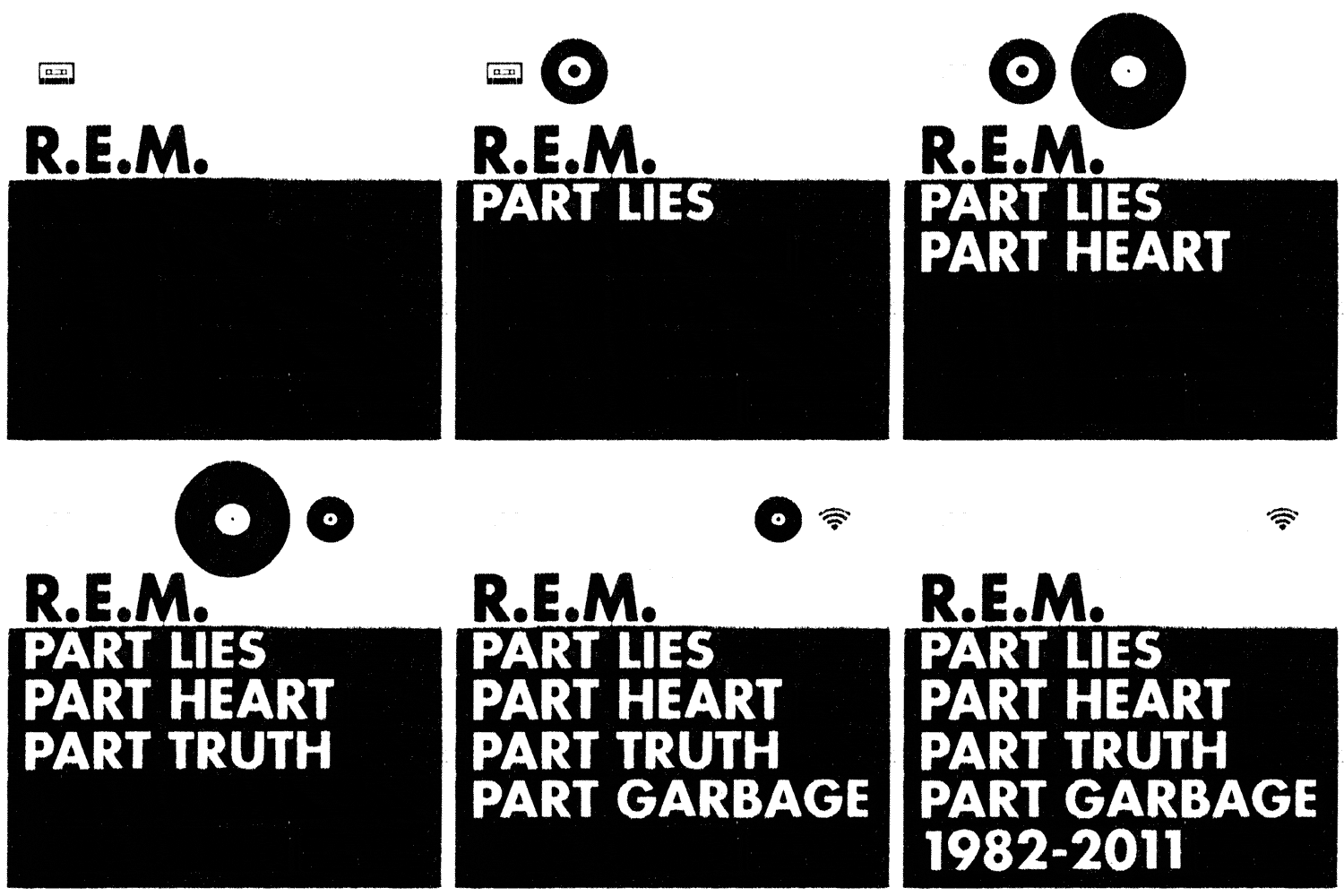
release date : 2011 November 15
a Stephen King story from The Atlantic : Herman Wouk Is Still Alive

Instead of going out for a bottle of Orange Driver to celebrate with, she pays off the MasterCard, which has been maxed like forever. Then calls Hertz and asks a question. Then calls her friend Jasmine, who lives in North Berwick, and tells her about the Pick-4. Jasmine screams and says, “Girl, you’re rich!”
If only. Brenda explains how she paid off the credit card so she can rent a Chevy Express if she wants to. It’s a van that seats nine, that’s what the Hertz girl told her. “We could get all the kids in there and drive up to Mars Hill. See your folks and mine. Show off the grandchildren. Squeeze ’em for a little more dough. What do you think?”
Jasmine is dubious. The glorified shack her folks call home doesn’t have room, and she wouldn’t want to stay with them even if it did. She hates those two. With good reason, Brenda knows; her own father broke Jasmine in at fifteen. Her mother knew what was going on and did nothing. When Jasmine went to her in tears, her ma said, “You got nothing to worry about, he’s had his nuts cut.”
Jas married Mitch Robicheau to get away from them, and now, three men, four kids, and eight years later, she’s on her own. And on welfare, although she gets sixteen hours a week at the Roll Around, handing out skates and making change for the video arcade, where the machines take only special tokens. They let her bring her two youngest. Delight sleeps in the office and Truth, her three-year-old, wanders around in the arcade hitching at his diapers. He doesn’t get into too much trouble, although last year he got head lice and the two women had to shave all his hair off. How he howled.
“There’s six hundred left over after I paid off the credit balance,” Brenda says. “Well, four hundred if you count the rental, only I don’t, because I can put that on MasterCard. We could stay at the Red Roof, watch Home Box. It’s free. We can get takeout from downstreet and the kids can swim in the pool. What do you say?”
From behind her comes yelling. Brenda raises her voice and screams, “Freddy, you stop teasing your sister and give that back!” Then, oh goody, their squabbling wakes up the baby. Either that or Freedom has messed in her diapers and awakened herself. Freedom always messes in her diapers. To Brenda it seems like Free is making poop her life’s work. Takes after her father that way.
“I suppose …” Jasmine says, drawing suppose out to four syllables. Maybe five.
“Come on, girl! Road trip! Get with the program! We take the bus down to the Jetport and rent the van. Three hundred miles, we can be there in four hours. The girl says they can watch DVDs. The Little Mermaid and all that good stuff.”
“Maybe I could get some of that government money from my ma before it’s all gone,” Jasmine says thoughtfully. Her brother Tommy died the year before, in Afghanistan. IED. Her ma and dad got eighty thousand out of it. Her ma has promised her some, although not when the old man is in hearing distance of the phone. Of course it may be gone already. Probably is. She knows Mr. Romance bought a Yamaha rice rocket, although what he wants with a thing like that at his age, Jasmine has no idea. And she knows things like government money are mostly a mirage. This is something they both know. Every time you see bright stuff, somebody turns on the rain machine. The bright stuff is never colorfast.
“Come on,” Brenda says. She has fallen in love with the idea of loading up the van with kids and her best (her only) friend from high school, who ended up living just one town over. Both of them on their own, seven kids between them, too many lousy men in the rearview, but sometimes they still have a little fun.
She hears a thunk sound. Freddy starts to scream. Glory has whopped him in the eye with an action figure.
“Glory you stop that or I’ll tear you a new one!” Brenda screams.
“He won’t give back my Powerpuff!” Glory shrieks, and she starts to cry. Now they’re all crying—Freddy, Glory, and Freedom—and for a moment grayness creeps over Brenda’s vision. She’s seen a lot of that grayness lately. Here they are in a three-room third-floor apartment, no guy in the picture (Tim, the latest in her life, took off six months ago), living pretty much on noodles and Pepsi and that cheap ice cream they sell at Walmart, no air-conditioning, no cable TV, she had a job at the Quik-Flash store but the company went busted and now the store’s an On the Run and the manager hired some Taco Paco to do her job because Taco Paco can work twelve or fourteen hours a day. Taco Paco wears a do-rag on his head and a nasty little mustache on his upper lip and he’s never been pregnant. Taco Paco’s job is to get girls pregnant. They fall for that little mustache and then boom, the line in the little drugstore testing gadget turns blue and here comes another one, just like the other one.
Brenda has personal experience; she tells people she knows who Freddy’s father is, but she really doesn’t, she had a few drunk nights when they all looked good, and really, come on, how is she supposed to look for a job anyway? She’s got these kids. What’s she supposed to do, leave Freddy to mind Glory and take Freedom to the goddamn job interviews? Sure, that’ll work. And what is there, besides drive-up-window girl at Mickey D’s or the Booger King? Portland has a couple of strip clubs, but wide loads like her don’t get that kind of work, and everyone else is broke.
She reminds herself she hit the lottery. She reminds herself they could be in a couple of air-conditioned rooms tonight at the Red Roof—three, even! Why not? Things are turning around!
“Brennie?” Her friend sounds more doubtful than ever. “Are you still there?”
“Yeah,” she says. “Come on, girl, I’m approved. The Hertz chick says the van is red.” She lowers her voice and adds: “Your lucky color.”
“Did you pay off the credit card online? How’d you do that?” Jasmine knows what happened to Brenda’s laptop. Freddy and Glory got fighting last month and knocked Brenda’s laptop off the bed. It fell on the floor and broke.
“I used the one at the library.” She says it the way she grew up in Mars Hill saying it: liberry. “I had to wait awhile to get on, but it’s worth it. It’s free. So what do you say?”
“Maybe we could get a bottle of Allen’s,” her friend says. Jasmine loves that Allen’s Coffee Brandy, when she can get it. In truth, Jasmine loves anything when she can get it.
“Apple-solutely,” Brenda says. “And a bottle of Driver for me. But I won’t drink while I’m behind the wheel, Jas. You can, but I’ll wait. I have to keep my license. It’s about all I got left.”
“Can you really get any money out of your folks, do you think?”
Brenda tells herself that once they see the kids—assuming the kids can be bribed (or intimidated) into good behavior—she can. “But not a word about the lottery,” she says.
“No way,” Jasmine says. “I was born at night but it wasn’t last night.”
They yuk at this one, an oldie but a goodie.
“So what do you think?”
“I’ll have to take Eddie and Rosellen out of school …”
“BFD,” Brenda says. “So what do you think, girl?”
After a long pause on the other end, Jasmine says, “Road trip!”
“Road trip!” Brenda hollers back.
Then they are chanting it while the three kids bawl in Brenda’s Sanford apartment and at least one (maybe two) is bawling in Jasmine’s North Berwick apartment. These are the fat women nobody wants to see when they’re on the streets, the ones no guy wants to pick up in the bars unless the hour is late and the mood is drunk and there’s nobody better in sight. What men think when they’re drunk—Brenda and Jasmine both know this—is that thunder thighs are better than no thighs at all. They went to high school together in Mars Hill and now they’re downstate and they help each other when they can. They are the fat women nobody wants to see, they have a litter of children between them, and they are chanting Road trip, road trip like a couple of cheerleading fools. On a September morning, already hot at eight-thirty, this is the way things happen. It’s never been any different.
Phil Henreid is seventy-eight now, and Pauline Enslin is seventy-five. They’re both skinny. They both wear spectacles. Their hair, white and thin, blows in the breeze. They’ve paused at a rest area on I-95 near Fairfield, which is about twenty miles north of Augusta. The rest-area building is barnboard, and the adjacent bathrooms are brick. They’re good-looking bathrooms. Modest bathrooms. There’s no odor. Phil, who lives in Maine and knows this rest area well, would never have proposed a picnic here in the summertime. When the traffic on the interstate swells with out-of-state vacationers, the Turnpike Authority brings in a line of plastic Port-O-Sans, and this pleasant grassy area stinks like hell on New Year’s Eve. But now the Port-O-Sans are in storage somewhere, and the rest area is nice.
Pauline puts a checked cloth on the initial-scarred picnic table standing in the shade of an old oak, and anchors it with a wicker picnic basket against a slight warm breeze. From the basket she takes sandwiches, potato salad, melon wedges, and two slices of coconut-custard pie. She also has a large glass bottle of red tea. Ice cubes clink cheerfully inside.
“If we were in Paris, we’d have wine,” Phil says.
“In Paris, we never had another sixty miles to drive on the turnpike,” she replies. “That tea is cold and it’s fresh. You’ll have to make do.”
“I wasn’t carping,” he says, and lays an arthritis-swollen hand over hers (which is also swollen, although marginally less so). “This is a feast, my dear.”
They smile into each other’s used faces. Although Phil has been married three times (and has scattered five children behind him like confetti) and Pauline has been married twice (no children, but lovers of both sexes in the dozens), they still have quite a lot between them. Much more than a spark. Phil is both surprised and not surprised. At his age—late, but not quite yet last call—you take what you can and are happy to get it. They are on their way to a poetry festival at the University of Maine’s Orono campus, and while the compensation for their joint appearance isn’t huge, it’s perfectly adequate. Since he has an expense account, Phil has splurged and rented a Cadillac from Hertz at the Portland Jetport, where he met her plane. Pauline jeered at this, said she always knew he was a plastic hippie, but she does it gently. He wasn’t a hippie, but he was a genuine whatever-he-was, and she knows it. As he knows that her osteoporotic bones have enjoyed the ride.
Now, a picnic. Tonight they’ll have a catered meal, but the food will be a lukewarm, sauce-covered mess o’ mystery supplied by the cafeteria in one of the college commons. “Beige food” is what Pauline calls it. Visiting-poet food is always beige, and in any case it won’t be served until eight o’clock. With some cheap yellowish-white wine seemingly created to saw at the guts of semi-retired alcohol abusers such as themselves. This meal is nicer, and iced tea is fine. Phil even indulges the fantasy of leading her by the hand to the high grass behind the bathrooms once they have finished eating, like in that old Van Morrison song, and—
Ah, but no. Elderly poets whose sex drives are now permanently stuck in first gear should not chance such a potentially ludicrous site of assignation. Especially poets of long, rich, and varied experience, who now know that each time is apt to be largely unsatisfactory, and each time may well be the last time. Besides, Phil thinks, I have already had two heart attacks. Who knows what’s up with her?
Pauline thinks, Not after sandwiches and potato salad, not to mention custard pie. But perhaps tonight. It is not out of the question. She smiles at him and takes the last item from the hamper. It is a New York Times, bought at the same Augusta convenience store where she got the rest of the picnic things, checked cloth and iced-tea bottle included. As in the old days, they flip for the Arts section. In the old days, Phil—who won the National Book Award for Burning Elephants in 1970—always called tails and won far more times than the odds said he should. Today he calls heads … and wins again.
“Why, you snot!” she cries, and hands it over.
They eat. They read the divided paper. At one point she looks at him over a forkful of potato salad and says, “I still love you, you old fraud.”
Phil smiles. The wind blows the gone-to-seed dandelion puff of his hair. His scalp shines gauzily through. He’s not the young man who once came roistering out of Brooklyn, broad-shouldered as a longshoreman (and just as foulmouthed), but Pauline can still see the shadow of that man, who was so full of anger, despair, and hilarity.
“Why, I love you, too, Paulie,” he says.
“We’re a couple of old crocks,” she says, and bursts into laughter. Once she had sex with a king and a movie star at pretty much the same time on a balcony while “Maggie May” played on the gramophone, Rod Stewart singing in French. Now the woman The New York Times once called America’s greatest living female poet lives in a walk-up in Queens. “Doing poetry readings in tank towns for dishonorable honorariums and eating alfresco in rest areas.”
“We’re not old,” he says, “we’re young, ma bébé.”
“What in the world are you talking about?”
“Look at this,” he says, and holds out the first page of the Arts section. She takes it and sees a photograph. It’s a dried-up string of a man wearing a straw hat and a smile.
As she looks at that old, seamed face beneath the rakishly tilted straw hat, Pauline feels the sudden sting of tears. “The body weakens but the words never do,” she says. “That’s lovely.”
“Have you ever read him?” Phil asks.
“Marjorie Morningstar, in my youth. It’s an annoying hymn to virginity, but I was swept away in spite of myself. Have you?”
“I tried Youngblood Hawke, but couldn’t finish it. Still … he’s in there pitching. And he’s old enough to be our father.” He folds the paper and puts it into the picnic basket. Below them, light traffic on the turnpike runs beneath a high September sky full of fair-weather clouds. “Before we get back on the road, do you want to do swapsies? Like in the old days?”
She thinks about it, then nods. Many years have passed since she listened to someone else read one of her poems, and the experience is always a little dismaying—like having an out-of-body experience—but why not? They have the rest area to themselves. “In honor of Herman Wouk, who’s still in there pitching. My work folder’s in the front pocket of my carrybag.”
“You trust me to go through your things?”
She gives him her old slanted smile, then stretches into the sun with her eyes closed. Relishing the heat. Soon the days will turn cold, but now there is heat. “You can go through my things all you want, Philip.” She opens one eye in a reverse wink that is amusingly seductive. “Explore to your heart’s content.”
“I’ll keep that in mind,” he says, and goes back to the Cadillac he has rented for them.
Poets in a Cadillac, she thinks. The very definition of absurdity. For a moment she watches the cars rush by. Then she picks up the Arts section and looks again at the narrow, smiling face of the old scribbler. Still alive. Perhaps at this very moment looking up at the high blue September sky, with his notebook open on a patio table and a glass of Perrier (or wine, if his stomach will still stand it) near to hand.
If there is a God, Paulie Enslin thinks, she can occasionally be very generous.
She waits for Phil to come back with her work folder and one of the steno pads he favors for composition. They will play swapsies. Tonight they may play other games. Once again she tells herself, It is not out of the question.
Everything is digital. There’s a satellite radio with a GPS screen above it. When she backs up, the GPS turns into a TV monitor, so you can see what’s behind you. Everything on the dashboard shines, that new-car smell fills the interior, and why not, with only seven hundred and fifty miles on the odometer? She has never in her life been behind the wheel of a motor vehicle with such low mileage. You can push buttons on the control-stalk to show you your average speed, how many miles per gallon you’re getting, and how many gallons you’ve got left. The engine makes hardly any noise at all. The seats up front are twin buckets, upholstered in bone-white material that looks like leather. The shocks are like butter.
In back is a pop-down TV screen with a DVD player. The Little Mermaid won’t work because Truth, Jasmine’s three-year-old, spread peanut butter all over the disc at some point, but they are content with Shrek, even though all of them have seen it like a billion times. The thrill is watching it while they’re on the road! Driving! Freedom is asleep in her car seat between Freddy and Glory; Delight, Jasmine’s six-month-old, is asleep in Jasmine’s lap, but the other five cram together in the two back seats, watching, entranced. Their mouths are hanging open. Jasmine’s Eddie is picking his nose, and Eddie’s older sister, Rosellen, has got drool on her sharp little chin, but at least they are quiet and not beating away at each other for once. They are hypnotized.
Brenda should be happy, she knows she should. The kids are quiet, the road stretches ahead of her like an airport runway, she’s behind the wheel of a brand-new van, and the traffic is light, especially once they leave Portland behind. The digital speedometer reads 70, and this baby hasn’t even broken a sweat. Nonetheless, that grayness has begun to creep over her again. The van isn’t hers, after all. She’ll have to give it back. A foolish expense, really, because what’s at the far end of this trip, up in Mars Hill? Food brought in from the Round-Up Restaurant, where she used to work when she was in high school and still had a figure. Hamburgers and fries covered with plastic wrap. The kids splashing in the pool before and maybe after. At least one of them will get hurt and bawl. Maybe more. And Glory will complain that the water is too cold, even if it isn’t. Glory always complains. She will complain her whole life. Brenda hates that whining and likes to tell Glory it’s her father coming out … but the truth is, the kid gets it from both sides. Poor kid. All of them, really. All poor kids, headed into poor lives.
She looks to her right, hoping Jas will say something funny and cheer her up, and is dismayed to see that Jasmine is crying. Silent tears well up in her eyes and shine on her cheeks. In her lap, baby Delight sleeps on, sucking one of her fingers. It’s her comfort-finger, and all blistered down the inside. Once, Jas slapped her good and hard when she saw Dee sticking it in her mouth, but what good is slapping a kid that’s only six months old? Might as well slap a door. But sometimes you do it. Sometimes you can’t help it. Sometimes you don’t want to help it. Brenda has done it herself.
“What’s wrong, girl?” Brenda asks.
“Nothing. Never mind me, just watch your driving.”
Behind them, Donkey says something funny to Shrek, and some of the kids laugh. Not Glory, though; she’s nodding off.
“Come on, Jas. Tell me. I’m your friend.”
“Nothing, I said.” Jas leans over the sleeping infant. Delight’s baby seat is on the floor. Resting in it on a pile of diapers is the bottle of Allen’s they stopped for in South Portland, before hitting the turnpike. Jas has only had a couple of sips, but this time she takes two good long swallows before putting the cap back on. The tears are still running down her cheeks. “Nothing. Everything. Comes to the same either way you say it, that’s what I think.”
“Is it Tommy? Is it your bro?”
Jas laughs angrily. “They’ll never give me a cent of that money, who’m I kidding? Ma’ll blame it on Dad because that’s easier for her, but she feels the same. It’ll mostly be gone, anyway. What about you? Will your folks really give you something?”
“Sure, I think so.” Well. Yeah. Probably. Like forty dollars. A bag and a half’s worth of groceries. Two bags if she uses the coupons in Uncle Henry’s Swap or Sell It Guide. Just the thought of flipping through that raggy little cheap magazine—the poor people’s Bible—and getting the ink on her fingers causes the grayness around her to thicken. The afternoon is beautiful, more like summer than September, but a world where you have to depend on Uncle Henry’s is a gray world. Brenda thinks, How did we end up with all these kids? Wasn’t I letting Mike Higgins cop a feel of me out behind the metal shop just yesterday?
“Bully for you,” Jasmine says, and snorks back tears. “My folks, they’ll have three new gasoline toys in the dooryard and then plead poverty. And do you know what my dad’ll say about the kids? ‘Don’t let ’em touch anything,’ that’s what he’ll say.”
“Maybe he’ll be different,” Brenda says. “Better.”
“He’s never different and he’s never better,” Jasmine says, “and he never will be.”
In the backseat, Rosellen is drifting off. She tries to put her head on her brother Eddie’s shoulder and he punches her in the arm. She rubs it and begins to snivel, but pretty soon she’s watching Shrek again. The drool is still on her chin. Brenda thinks it makes her look like an idiot, which she pretty close to is.
“I don’t know what to say,” Brenda says. “We’ll have some fun, anyway. Red Roof, girl! Swimming pool!”
“Yeah, and some guy knocking on the wall at one in the morning, telling me to shut my kid up. Like, you know, I want Dee awake in the middle of the night because all those stinkin’ teeth are coming in at once.”
She takes another slug from the coffee-brandy bottle, then holds it out to Brenda. Brenda knows better than to take it, to risk her license … but no cops are in sight and if she did lose her ticket, how much would she really be out? The car was Tim’s, he took it when he left, and it was a half-dead beater anyway, a Bondo-and-chicken-wire special. No great loss there. Besides, there’s that grayness. She takes the bottle and tips it. Just a little sip, but the brandy’s warm and nice, a shaft of dark sunlight, so she takes another one.
“They’re closing the Roll Around at the end of the month,” Jasmine says, taking the bottle back.
“Jassy, no!”
“Jassy yes.” She stares straight ahead at the unrolling road. “Jack finally went broke. The writing’s been on the wall since last year. So there goes that ninety a week.” She drinks. In her lap, Delight stirs, then goes back to sleep with her comfort-finger plugged in her gob. Where, Brenda thinks, some boy like Mike Higgins will want to put his dick not all that many years from now. And she’ll probably let him. I did. Jas did too. It’s just how things go.
Behind them Princess Fiona is now saying something funny, but none of the kids laugh. They’re getting glassy, even the older kids. Eddie and Freddy, names like a TV-sitcom joke.
“The world is gray,” Brenda says. She didn’t know she was going to say those words until she hears them come out of her mouth.
Jasmine looks at her, surprised. “That’s right,” she says. “Now you’re getting with the program.”
Brenda says, “Pass me that bottle.”
Jasmine does. Brenda drinks some more, then hands it back. “Okay, enough of that.”
Jasmine gives her her old sideways grin, the one Brenda remembers from study hall on Friday afternoons. It looks strange, below her wet cheeks and bloodshot eyes. “You sure?”
Brenda doesn’t reply, but she pushes the accelerator a little deeper with her foot. Now the digital speedometer reads 80.
All at once she feels shy, afraid to hear her words coming out of Phil’s mouth, sure they will sound booming yet false, like dry thunder. But she has forgotten the difference between his public voice—declamatory and a little corny, like the voice of a movie attorney in a summing-up-to-the-jury scene—and the one he uses when he’s with just a friend or two (and hasn’t had anything to drink). It is a softer, kinder voice, and she is pleased to hear her poem coming out of his mouth. No, more than pleased. She is grateful. He makes it sound far better than it is.
Shadows print the road
with black lipstick kisses.
Decaying snow in farmhouse fields
shines like cast-off bridal dresses.
The rising mist turns to gold dust.
The clouds boil apart and a phantom disc
seems to race behind them.
It bursts through!
For five seconds it could be summer
and I seventeen with flowers
in the lap of my dress.He puts the sheet down. She looks at him, smiling a little, but anxious. He nods his head. “It’s fine, dear,” he says. “Fine enough. Now you.”
She opens the steno pad, finds what appears to be the last poem, and pages through four or five scribbled drafts. She knows how he works, and she goes on until she comes to a version not in mostly illegible cursive but in small neat printing. She shows it to him. Phil nods, then turns to look at the turnpike. All of this is very nice, but they will have to go soon. They don’t want to be late.
He sees a bright-red van coming. It’s going fast.
She begins.
Yes, she thinks, that’s just about right. Thanksgiving for fools.
Freddy will go for a soldier and fight in foreign lands, the way Jasmine’s brother Tommy did. Jasmine’s boys, Eddie and Truth, will do the same. They’ll own muscle cars when and if they come home, and if gas is still available twenty years from now. And the girls? They’ll go with boys. They’ll give up their virginity while game shows play on TV. They’ll have babies and fry meat in skillets and put on weight, same as she and Jasmine did. They’ll smoke a little dope and eat a lot of ice cream—the cheap stuff from Walmart. Maybe not Rosellen, though. Something is wrong with Rosellen. She’ll need to go to the special-ed classes. She’ll still have drool on her sharp little chin when she’s in the eighth grade, same as now. The seven kids will beget seventeen, and the seventeen will beget seventy, and the seventy will beget two hundred. She can see a ragged fool’s parade marching into the future, some wearing jeans that show the ass of their underwear, some wearing heavy-metal T-shirts, some wearing gravy-spotted waitress uniforms, some wearing stretch pants from Kmart that have little MADE IN PARAGUAY tags sewn into the seams of the roomy seats. She can see the mountain of Fisher-Price toys they will own and that will later be sold at yard sales (which was where most were bought in the first place). They will buy the products they see on TV and go in debt to the credit-card companies, as she did … and will again, because the Pick-4 was a fluke and she knows it. Worse than a fluke, really: a tease. Life is basically a rusty hubcap lying in a ditch at the side of the road, and life goes on. She will never again feel like she’s sitting in the cockpit of a jet fighter. This is as good as it gets. Her ship will not come in. There are no boats for nobody, and no camera is filming her life. This is reality, not a reality show.
Shrek is over and all the kids are asleep, even Eddie. Rosellen’s head is once more on Eddie’s shoulder. She’s snoring like an old woman. She has red marks on her arms, because sometimes she can’t stop scratching herself.
Jasmine screws the cap on the bottle of Allen’s and drops it back into the baby seat in the footwell. In a low voice she says, “When I was five, I believed in unicorns.”
“So did I,” Brenda says. She looks at Jasmine. “I wonder how fast this thing goes.”
Jasmine looks at the road ahead. They flash past a blue sign that says REST AREA 1 MI. She sees no traffic northbound; both lanes are entirely theirs. “Let’s find out,” Jasmine says.
The numbers on the speedometer rise from 80 to 85. Then 87. There’s still some room left between the accelerator pedal and the floor. All the kids are sleeping.
Here is the rest area, coming up fast. Brenda sees only one car in the parking lot. It looks like a fancy one, a Lincoln or maybe a Cadillac. I could have rented one of those, she thinks. I had enough money but too many kids. Couldn’t fit them all in. Story of her life, really.
She looks away from the road. She looks at her old friend from high school, who ended up living just one town away. Jasmine is looking back at her. The van, now doing almost a hundred miles an hour, begins to drift.
Jasmine gives a small nod and then lifts Dee, cradling the baby against her big breasts. Dee’s still got her comfort-finger in her mouth.
Brenda nods back. Then she pushes down harder with her foot, trying to find the van’s carpeted floor. It’s there, and she lays the accelerator pedal softly against it.
He reaches out and grabs her shoulder with his bony hand, startling her. She looks up from his poem and sees him staring at the turnpike. His mouth is open and behind his glasses his eyes appear to be bulging out almost far enough to touch the lenses. She follows his gaze in time to see a red van slide smoothly from the travel lane into the breakdown lane and from the breakdown lane across the rest-area entrance ramp. It doesn’t turn in. It’s going far too fast to turn in. It crosses, doing at least ninety miles an hour, and plows onto the slope just below them, where it hits a tree. She hears a loud, toneless bang and the sound of breaking glass. The windshield disintegrates; glass pebbles sparkle for a moment in the sun and she thinks—blasphemously—beautiful.
The tree shears the van into two ragged pieces. Something—Phil Henreid can’t bear to believe it’s a child—is flung high into the air and comes down in the grass. Then the van’s gas tank begins to burn, and Pauline screams.
He gets to his feet and runs down the slope, vaulting over the shakepole fence like the young man he once was. These days his failing heart is seldom far from his mind, but as he runs down to the burning pieces of the van, he never even thinks of it.
Cloud-shadows roll across the field, then across the woods beyond. Wildflowers nod their heads.
He stops twenty yards from the gasoline funeral pyre, the heat baking his face. He sees what he knew he would see—no survivors—but he never imagined so many non-survivors. He sees blood on the grass. He sees a shatter of taillight glass like a patch of strawberries. He sees a severed arm caught in a bush. In the flames he sees a melting baby seat. He sees shoes.
Pauline comes up beside him. She’s gasping for breath. The only thing wilder than her hair are her eyes.
“Don’t look,” he says.
“What’s that smell? Phil, what’s that smell?”
“Burning gas and rubber,” he says, although that’s probably not the smell she’s talking about. “Don’t look. Go back and—do you have your cell phone?”
“Yes, of course I have it—”
“Go back and call 911. Don’t look at this. You don’t want to see this.”
He doesn’t want to see it either, but cannot look away. How many? He can see the bodies of at least three children and one adult—probably a woman, but he can’t be sure. Yet so many shoes … and all the clothes … he can see a DVD package …
“What if I can’t get through?” she asks.
He points to the smoke. Then to the three or four cars that are already pulling over. “Getting through won’t matter,” he says, “but try.”
She starts to go, then turns back. She’s crying. “Phil … how many?”
“I don’t know. A lot. Go on, Paulie. Some of them might still be alive.”
“You know better,” she says through her sobs. “Damn thing was going too fast.”
She begins trudging back up the hill. Halfway to the rest-area parking lot (more cars are pulling in now), a terrible idea crosses her mind and she looks back, sure she will see her old friend and lover lying in the grass himself, perhaps clutching his chest, perhaps unconscious. But he’s on his feet, cautiously circling the blazing left half of the van. As she watches, he takes off his natty sport jacket with the patches on the elbows. He kneels and covers something with it. Either a person or a part of a person. Then he goes on.
Climbing the hill, she thinks that all their efforts to make beauty out of words is an illusion. Or a joke played on children who have selfishly refused to grow up. Yes, probably that. Children like that, she thinks, deserve to be pranked.
As she reaches the parking lot, still gasping for breath, she sees the Times Arts section flipping lazily through the grass on the breath of a light breeze and thinks, Never mind. Herman Wouk is still alive and writing a book about God’s language. Herman Wouk believes that the body weakens, but the words never do. So that’s all right, isn’t it?
A man and a woman rush up. The woman raises her own cell phone and takes a picture with it. Pauline Enslin observes this without much surprise. She supposes the woman will show it to friends later. Then they will have drinks and a meal and talk about the grace of God. God’s grace looks intact every time it’s not you.
“What happened?” the man shouts into her face.
Down below them a skinny old poet is happening. He’s now naked to the waist. He has taken off his shirt to cover one of the other bodies. His ribs are a stack outlined against white skin. He kneels and spreads the shirt. He raises his arms into the sky, then lowers them and wraps them around his head.
Pauline is also a poet, and as such feels capable of answering the man in the language God speaks.
“What the fuck does it look like?” she says.
2011
theatlantic.com
promo : Nickelback’s Here And Now album
a Tweet from Stephanie Mills thanking me for following her
@marcelleedotcom Hi Marcel, Thank you for your follow.
— Stephanie Mills (@PrettyMill1) September 19, 2011