
1991
Tag: politics
Asshole ( song ) … Denis Leary
1993
video review : Malcolm X
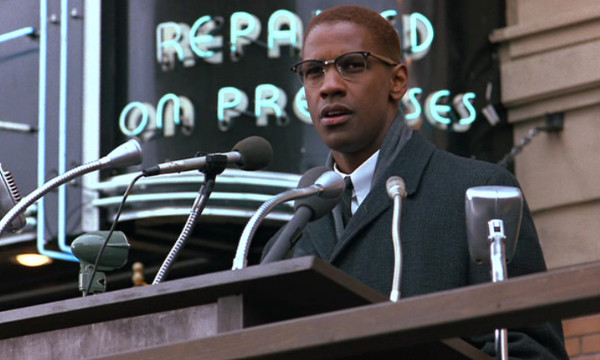
If this Spike Lee Joint, which plays as a neutral biography for three hours before suddenly transitioning into a propaganda piece, presents an accurate portrayal of Malcolm X, I don’t think his legacy deserves celebration. His mission, to lift the social oppression of the black race, was a commendable one. Racism, primarily by white people toward black people, which remains an issue today, was even more of a problem during his lifetime; the end of which happened to coincide with the end of The Civil Rights Movement; but he too was a racist. He was a brainwashed follower of The Honorable Elijah Muhammad, The Nation Of Islam and all their anti-white philosophies for a long time.
That Malcolm X may have began to shed his bias during his final chapters; it wasn’t until he made his pilgrimage to Mecca that he realized not all white people are devils; isn’t good enough. Accurate or not, Spike Lee has done a remarkable job of visually depicting the life of a man I may not have otherwise cared enough to learn about, but the man we’re supposed to be praising comes across as not much more than a buffoon. As educated as he is when it comes to the English language; he studied every word in “the white man’s” dictionary; he doesn’t seem to be much of a thinker in the way of general logic; the kind Martin Luther King had that says you can’t end racism with racism.
my rating : 4 of 5
1992
DS ( song ) … Michael Jackson
1995
audio review : Return Of The Boom Bap ( album ) … KRS-One
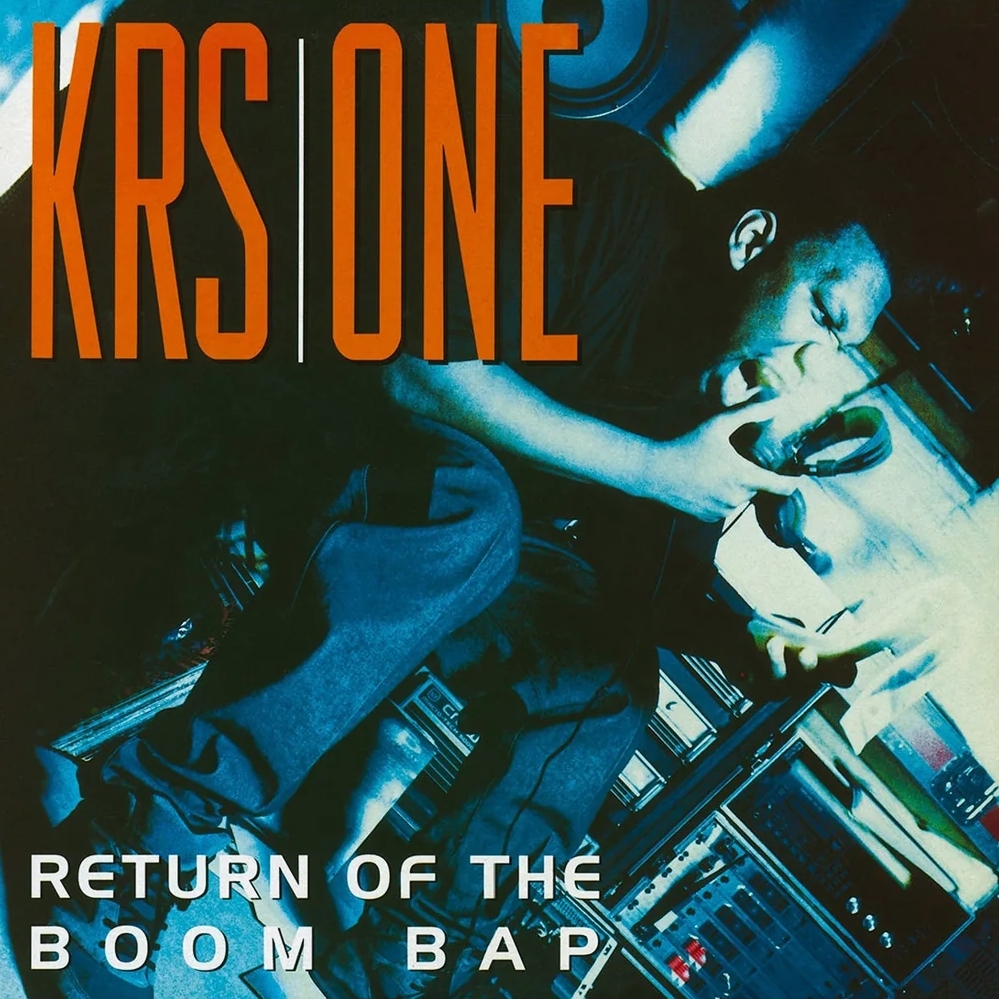
“Return Of The Boom Bap means just that,” KRS-One explains, “It means return of the real hard beats and real rap.” It’s the word “Return” that confuses me because KRS-One, whose albums should’ve always been credited under that name, never fell off. His albums have been on-point at least since The Blueprint. Maybe he’s saying that rap music in general has fallen off. If that’s the case, this album brings it back.
The verses are about as Edutaining as always. The beats, some of which are produced by DJ Premier, stay true to the concept. Despite KRS-One using headphones as a mic on the cover photo, the album’s mixing and mastering sounds slicker and smoother than usual. Other than that, it’s not much different than the other albums. He’s still a rapper with a thing for reggae who’s main objection is to uplift the black race.
A Brown Skin Woman, as far as he’s concerned, is a queen, not a ho, though he refers to one as such just two songs later. He compares Da Police to the overseers of slave plantations and when he addresses white kids, on a beat-box narrative about teen peer pressure, he does so with a hint of animosity. He puts them in the cynical scenario of ganging-up to bully an innocent youth. “And yes, that youth is black.”
There has long been a fine line between being pro-black and being anti-white. Other rappers have certainly crossed that line, but, though he comes close, I don’t think KRS-One has reached that point. Even if he has, that doesn’t take anything away from his skills as an MC and overall rap artist. He’s not quite as skilled as he thinks he is, but he’s the real deal. He’s a hip-hop purist if there ever was such a thing.
my rating : 4 of 5
1993
The Alex Jones Show : a caller accusing Alex of being a fraud
2010
infowars.com
The Alex Jones Show : Alex getting frustrated with a caller named Mario
2007
infowars.com
a poem by KRS-One : The Homeless
1990
video review : Fair Game

This movie, based on a memoir by former CIA agent Valerie Plame Wilson, seems to have its political views in the right place. It’s not afraid to portray the US government as the corrupt organization it often is. The main focus goes back to the weeks, months and years after “9-11” and the questionable war that started as a result.
The plot, about Valerie’s sudden termination from the CIA; the result of her ambassador husband publicly denying that Saddam Hussein is using “yellowcake” to make weapons; doesn’t really untangle itself until about the half-way point. From there, this Fair Game is two people versus the government in what is ultimately anything but.
my rating : 3 of 5
2010